In today’s fast-paced software industry, companies must deliver high-quality products quickly and cost-effectively. Traditional development models often create bottlenecks, introduce waste, and hinder the ability to respond to evolving customer needs.
In today’s fast-paced software industry, companies must deliver high-quality products quickly and cost-effectively. Traditional development models often create bottlenecks, introduce waste, and hinder the ability to respond to evolving customer needs. This is where Lean Software Development provides a solution. Rooted in lean manufacturing principles pioneered by Toyota, it focuses on efficiency and waste reduction to streamline the development process.
Lean Software Development aims to optimize value delivery and empower teams, ensuring that software meets customer needs while upholding high-quality standards. In this article, we’ll explore what Lean Software Development is, its key principles, and why it’s a valuable approach for modern software teams.
What is Lean Software Development?
Lean Software Development is a methodology designed to maximize value while minimizing waste throughout the software development process. Based on continuous improvement principles from lean manufacturing, it emphasizes streamlining workflows, empowering teams, and delivering high-quality results with fewer resources.
The core concept of Lean is simple: eliminate anything that doesn’t add value to the customer or the product. This philosophy encourages incremental delivery, continuous feedback, and a culture of learning, allowing teams to adapt quickly and build better software faster.
Unlike traditional development models that focus on large, rigid projects, Lean Software Development breaks down tasks into smaller, manageable increments. By focusing on what truly matters, teams can reduce waste and deliver efficient results at a faster pace.
Why Lean Software Development Works
Eliminating Waste: Lean focuses on identifying and removing any activities, processes, or features that do not add value to the customer or the product. Waste can be time spent on unnecessary features, overproduction, redundant processes, or anything that delays the delivery of valuable software.
Faster Delivery: Lean encourages incremental development, meaning that teams deliver smaller chunks of work at regular intervals. This not only speeds up feedback but ensures that products are delivered in usable iterations, allowing for quicker adaptations based on customer feedback and market demands.
Empowering Teams: Lean Software Development places trust in development teams, empowering them to make decisions based on their deep understanding of the work. This decentralization of decision-making improves efficiency, reduces delays, and boosts team morale by allowing them to take ownership of their work.
Continuous Learning: Learning is central to Lean Software Development. Teams are encouraged to experiment, gather feedback, and continuously improve their work. This iterative process, often referred to as “discovery cycles” (Design, Implement, Feedback, Improve), ensures that the product evolves in alignment with the customer’s changing needs.
The Seven Principles of Lean Software Development
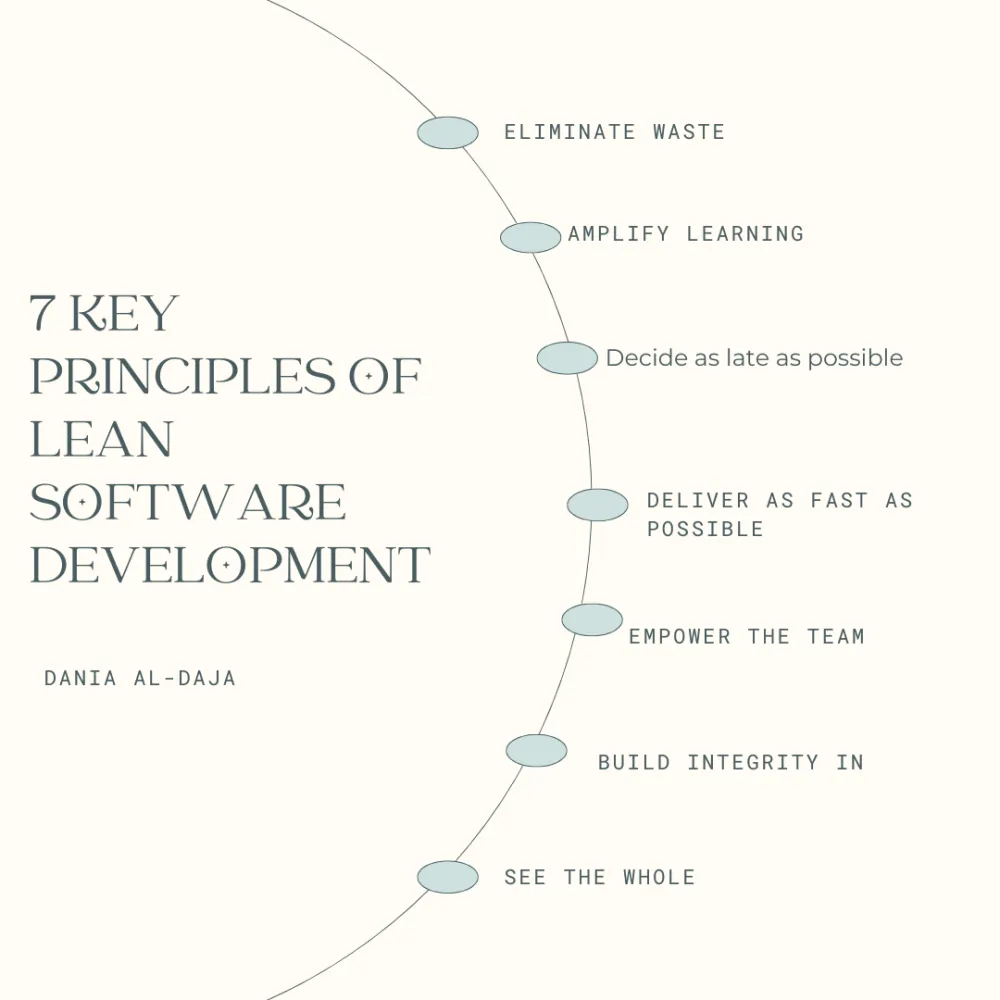
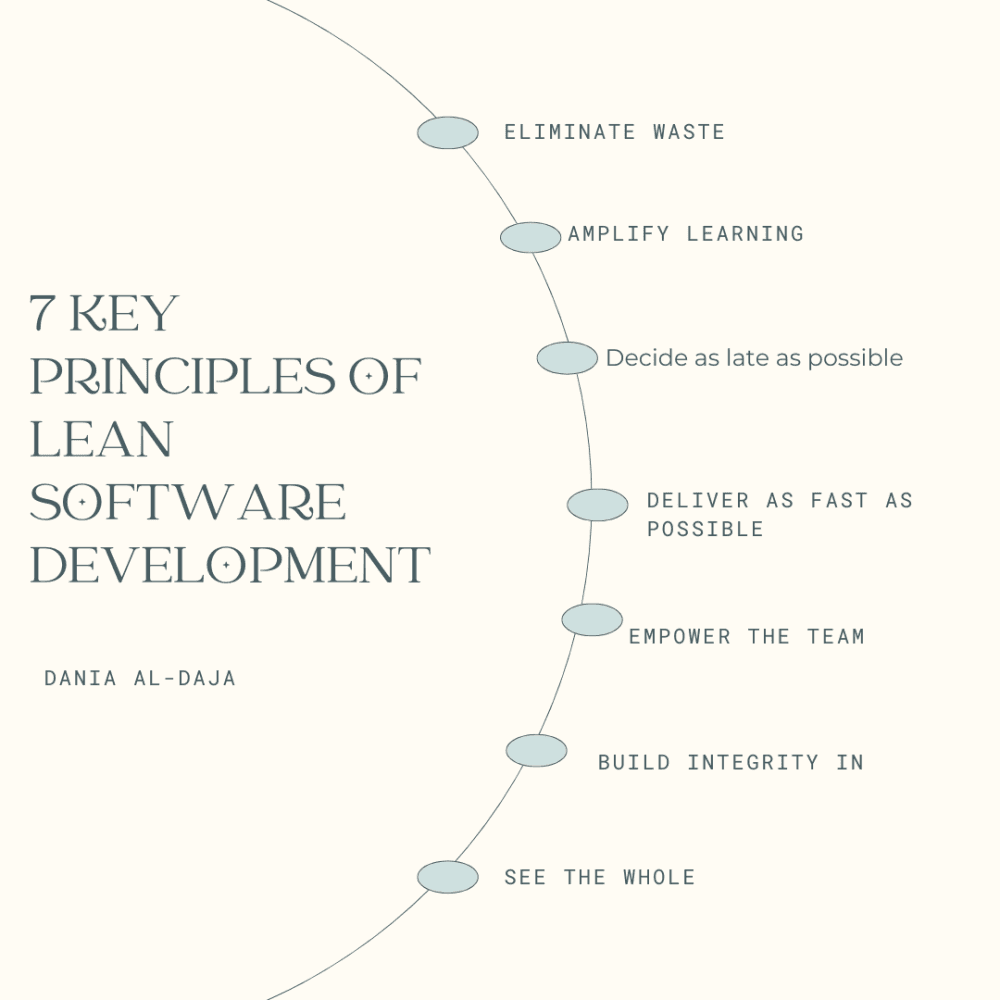
Lean Software Development is based on seven core principles outlined by Mary and Tom Poppendieck in their 2003 book Lean Software Development: An Agile Toolkit.
Press enter or click to view image in full size
These principles guide teams in applying Lean to software development:
Eliminate Waste: Anything that doesn’t add value to the product, whether it’s time, resources, or effort, is considered waste and should be eliminated. This includes unnecessary documentation, features, and delays.
Amplify Learning: Software development is a learning process, not just a production process. Lean encourages continuous learning through feedback loops, allowing teams to iterate and improve based on real-world use and evolving customer feedback.
Decide as Late as Possible: In software development, uncertainty is inevitable. Lean advocates deferring decisions until they are absolutely necessary to avoid committing to potentially faulty assumptions early in the process. This gives teams the flexibility to make more informed decisions as new information becomes available.
Deliver as Fast as Possible: Speed is crucial in Lean Software Development. Rapid delivery reduces the risk of the product becoming outdated by the time it’s released, and it allows teams to respond quickly to customer needs. Fast delivery also enables quicker feedback and more iterations, promoting constant improvement.
Empower the Team: Lean emphasizes that the people who are closest to the work are the best equipped to make decisions. Teams should be empowered to make choices, solve problems, and improve processes on their own without waiting for approval from higher management. This increases responsiveness and efficiency.
Build Integrity In: Lean Software Development encourages building quality into the product from the start. By focusing on high standards, adaptable code, and extensible design, the software maintains its integrity as it evolves. This is essential for creating long-term value and sustainable growth.
See the Whole: Lean advocates for a holistic view of the entire development process. Instead of focusing on individual tasks or teams, Lean encourages teams to consider the entire value stream, ensuring that all parts of the process are aligned and optimized toward the final product’s success.
Real-World Applications
Lean Software Development has proven its value in diverse contexts, from emerging startups to established enterprises, across industries like healthcare, finance, and technology. Its flexibility and focus on delivering value make it a versatile approach to software development.
Revitalizing Stagnant Workflows: Organizations weighed down by inefficiency and outdated processes can benefit from Lean’s emphasis on waste reduction. By streamlining workflows and fostering better collaboration, teams can improve productivity and deliver high-quality software without unnecessary delays or complexity.
Adapting to Shifting Needs: In fast-paced environments where customer demands or market conditions are constantly evolving, Lean provides the adaptability required to respond effectively. Teams can iterate quickly, make informed decisions at the right time, and ensure that the product aligns with current requirements.
Maximizing Startup Potential: Startups often operate with tight budgets and limited resources, making Lean’s principles an excellent fit. By focusing on incremental product delivery
Conclusion
Lean Software Development offers a compelling alternative to traditional development methods by focusing on efficiency, quality, and responsiveness. Its principles help teams eliminate waste, increase speed, and deliver higher-value products to customers. Whether applied in a startup, a large enterprise, or an evolving market, Lean enables companies to stay competitive and continuously improve.
The strength of Lean lies in its emphasis on empowering teams, making data-driven decisions, and maintaining flexibility throughout the software development process. As customer demands continue to evolve, Lean Software Development offers the tools necessary to adapt quickly and continuously deliver value.
Resources:
Poppendieck, Mary, and Tom Poppendieck. Lean Software Development: An Agile Toolkit. Addison-Wesley Professional, 2003.
Womack, James P., and Daniel T. Jones. Lean Thinking: Banish Waste and Create Wealth in Your Corporation. Free Press, 1996.
The Lean Enterprise Institute: www.lean.org
Kniberg, Henrik. Kanban and Scrum — Making the Most of Both. InfoQ, 2009.
Highsmith, Jim. Agile Project Management: Creating Innovative Products. Addison-Wesley, 2009.
Cohn, Mike. Succeeding with Agile: Software Development Using Scrum. Addison-Wesley, 2010.
Official Scrum Guide: www.scrumguides.org
Scrum Alliance: www.scrumalliance.org